
A PDO thread lift offers a minimally invasive for those who are starting to see early signs of facial sagging, but do not want to deal with the incisions and recovery from facelift surgery. The process involves the insertion of absorbable polydioxanone (PDO) threads under the skin to move certain soft tissues into place. The effect of lifting threads is achieved by barbs or cogs which engage the tissue and provide mechanical support; the body’s healing reaction around the threads may induce changes in the tissue with collagen.
A PDO thread lift can provide a mild, temporary lift in carefully selected patients, but cannot achieve the same level of correction as an actual facelift. Recent studies also revealed minimal solid data on the sustainability of absorbable facial thread lifts.
What Is a PDO Thread Lift?
PDO thread lift is a procedure that employs polydioxanone (PDO) a material that is used in surgical sutures and cosmetic treatments. A needle or cannula is inserted into the skin and threads are placed under the skin which are engaged by lifting threads, and the tissue is moved along intended vectors and then slowly broken down over an extended period of time.
Is PDO Thread Lift Really Non-Surgical?
A PDO thread lift is not entirely non invasive as it goes through the skin and threads are placed under it typically with the use of local anaesthetic. It is not a facelift and does not necessitate large incisions and dissection of surgical tissue.
How Does a PDO Thread Lift Work?
A PDO thread lift is a mechanical repositioning of tissues combined with a healing response of the tissues around the threads. Barbed or cog threads pick up chosen soft tissue and healing can cause tissue changes that are collagen based without permanently lifting the tissue.
Immediate Mechanical Lifting
Barbed or cog threads work by stimulating mechanical tension in tissue, which may reposition the cheeks, early jowls, jawline or temporal tissue in a targeted direction and amount of tension (lifting vector).
Healing Response Around PDO Threads
When PDO threads are placed the area will heal which could cause the change of tissue around the threads, due to collagen. However collagen formation is not enough to make the mechanical lifting effect last.
Types of PDO Threads
Mono or Smooth PDO Threads
Mono threads primarily hold the skin and stimulate tissue reaction, but do not provide as much mechanical lifting as barbed threads.
Cog or Barbed PDO Threads
Cog threads lift the skin with soft tissue to aid mechanical lifting, repositioning of tissue, definition of the jawline and mild elevation of the jowls.
Screw / Twisted Threads
Screw or twisted threads may provide selected volumetric or tissue supporting effects as per the system and treatment plan.
PDO vs PLLA vs PCL Threads
| PDO | PLLA | PCL |
| Polydioxanone | Poly-L-lactic acid | Polycaprolactone |
| Absorbable | Absorbable | Absorbable |
| Commonly used in thread lifting | Selected thread systems | Selected longer-degrading systems |
| Temporary mechanical support | Temporary support | Temporary support |
| Depends on product and design | Product specific | Product specific |
Which Areas Can PDO Thread Lifts Treat?
Midface and Cheeks
PDO lifting threads can move slightly drooping cheek tissue and give a slight uplift to the contour of the mid face.
Jawline
In certain cases, repositioning the selected soft tissue with threads may temporarily enhance the definition of a mandibular border that is just slightly blurred.
Early Jowls
PDO threads may offer some slight repositioning of early jowls for appropriately chosen patients. They do not take jowl tissues or surplus skin away.
Lateral Brow / Temporal Area
Certain PDO techniques may achieve temporary lift in the lateral brow. More studies are underway to study PDO thread lifting techniques for lifting the eyebrows; the outcome varies based on the technique and patient’s anatomy.
Neck
For cases of mild neck laxity, a thread treatment is a good option. If there is significant laxity of the neck, this will need to be treated in a different way.
What Can PDO Threads Not Correct?
PDO thread lifting cannot guarantee to correct the following:
- Severe jowling
- Excessive skin folds
- Advanced neck laxity
- A large amount of fat deposits in the face area
- Severe volume loss
- Major skeletal imbalance
- Deep structural ageing
Depending on the underlying problem, a practitioner may instead recommend dermal fillers, biostimulatory treatments, HIFU, radiofrequency skin tightening, fat treatments, facelift surgery or neck lift surgery.
Who Is a Good Candidate for PDO Thread Lift?
Potential candidates may have:
- Light facial tissue fall
- Early jowls
- Some jawline definition loss
- Relatively good skin elasticity
- Adequate tissue thickness
- Realistic expectations
- Preference for a smaller intervention than facelift surgery
Who May Be a Poor Candidate?
A PDO thread practitioner may advise the patient to avoid using PDO threads if they have:
- Severe facial laxity
- Facial tissue that is very heavy
- Very thin skin
- Major jowling
- Significant neck laxity
- Active facial infection
- Poor wound healing
- Significant bleeding disorders
- Uncontrolled systemic illness
- Previous bad permanent threads
- Unrealistic expectations
Consultation Before PDO Thread Lift
The practitioner evaluates your facial anatomy, skin quality, skin thickness, fat distribution, skin laxity, past treatments and medical history to decide if PDO threads are right for you.
Facial Vector Planning
Planning the entry points, the thread pathway, anchor points, number of threads and direction of lifting; all of these could affect the outcome or complexity of the work and will be planned by the practitioner.
PDO Thread Lift Procedure Step by Step
Step 1 – Facial Assessment and Photography
Standardised photos are taken to document the baseline position, symmetry and area treated.
Step 2 – Mapping the Lift
The practitioner draws the intended thread pattern and the entry points on your face based on your facial structure.
Step 3 – Cleansing and Sterile Preparation
Face is washed and treated with sterile methods to minimise the risk of infection.
Step 4 – Local Anaesthesia
Local anaesthetic is routinely injected around entry points and around chosen thread pathways to reduce pain.
Step 5 – Cannula or Needle Entry
A needle or cannula is delicately inserted under the skin into the designated tissue plane.
Step 6 – PDO Thread Placement
The practitioner passes the PDO threads in the pre-designed tissue plane.
Step 7 – Tissue Engagement
Barbed or cog threads interlock with the surrounding soft tissue with their respective barbs or cogs.
Step 8 – Lifting and Repositioning
Controlled tension pulls the chosen tissue back and forth in along the desired lifting path.
Step 9 – Thread Trimming
Once the desired tissue position is obtained the practitioner cuts off the extra thread.
Step 10 – Final Assessment
The practitioner assesses symmetry, dimpling, skin colour, pain, visibility of the thread and irregularities of the contour.
How Many PDO Threads Do You Need?
The number of PDO threads that suit every individual is not the same.
The number required is dependent on:
- Facial area
- Degree of laxity
- Thread design
- Desired correction
- Tissue weight
- The need for treatment on one or both sides
- Manufacturer technique
- Practitioner strategy
Are PDO Thread Lift Results Immediate?
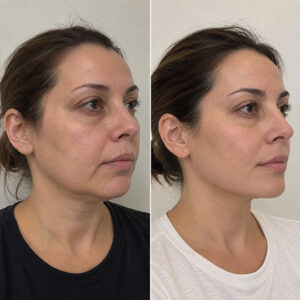
The appearance of PDO thread lift may be partially immediate as the threads mechanically reposition the selected tissue but swelling, temporary overcorrection, puckering and dimpling, local anaesthetic can impact early appearance.
The final settled result may not be captured with an immediate before and after photo as tissues are still adjusting during a recovery period.
When Does a PDO Thread Lift Look Natural?
Immediately after a PDO thread lift, the area may appear tight, uneven or slightly puckered and may be swollen and slightly asymmetric during the initial recovery period. Often these effects will resolve as the tissue adapts but if the changes become more aggravated or continue they should be assessed by a professional.
How Long Does a PDO Thread Lift Last?
PDO thread lift results are visible for several months, with the clinical data of a multicentre review showing that the lifting effect lasted about 6 – 12 months and PDO material had a tendency to wear off after about 6 – 8 months.
The length of time will depend on the individual patient, the area being treated, the type of material being used and available information on long term effectiveness is limited so you should not expect lasting lift.
What Happens When PDO Threads Dissolve?
Over time, PDO degrades and diminishes in mechanical support with some fibrotic and collagenous tissue reactions remaining for a short time.
The tissue continues to age naturally and treated tissue may naturally sink back down over time but the tissues do not suddenly fall off when the threads dissolve.
PDO Thread Lift Recovery
First 24–48 Hours
There can be some swelling, tenderness, tightness, bruising and mild dimpling in the first 24-48 hours.
First Week
It can be tight, trigger some slight discomfort when chewing and/or your face may be slightly asymmetric for a while.
Following Weeks
If swelling and irregularity is not too serious, it should slowly get better as tissues adapt.
The speed of recovery will depend upon the number of threads, area of treatment, type of thread, technique and individual tissue response.
PDO Thread Lift Aftercare
Aftercare will vary depending on the area being treated and the type of thread used so follow the doctor’s specific guidelines.
Some general guidance may be given as:
- Do not put pressure or massage when not necessary.
- Do not use aggressive facial care until cleared.
- Avoid over manipulation of the face.
- Maintain clean entrances.
- Avoid strenuous exercise as directed by your doctor.
- Be sure to follow up appointments.
Contact the clinic promptly for:
- Increasing pain
- Increasing redness
- Pus
- Fever
- Worsening swelling
- Thread exposure
- Persistent severe dimpling
- New facial weakness
- Significant asymmetry
PDO Thread Lift Risks and Complications
PDO thread lifting can cause complications such as swelling, bruising, pain, dimpling, contour irregularity, visible threads, extrusion, migration, infection, fibrosis, asymmetry and foreign body reactions.
Swelling and Bruising
Typical early changes that typically improve through recovery.
Pain and Tenderness
This is typically temporary but may be worsening or serious pain, and should be evaluated.
Skin Dimpling
Puckering, depression or tissue tethering due to thread traction.
Contour Irregularity
Skin surface may be uneven following treatment.
Visible or Palpable Threads
In the case of thin skin, threads can show or be seen under the skin.
Thread Extrusion
Some of the thread can rise through the skin, and need a professional evaluation.
Thread Migration
Thread can migrate from the usual position and impact on the treatment outcome.
Infection
PDO threads can also be a source of infection as they stay under the skin, and if they get an infection, it needs to be treated immediately.
Asymmetry
Due to anatomical or tissue response differences, one side might lift differently than the other.
Granuloma / Foreign-Body Reaction
Long term inflammatory reactions can occur surrounding the implant.
Nerve or Anatomical Injury
During thread placement, detailed knowledge of facial anatomy is always crucial as it is for the safe placement of facial nerve branches, blood vessels and parotid structures.
Can PDO Threads Be Removed?
In some cases, yes, but it is not easy to dissolve hyaluronic acid filler.
Management depends on:
- Thread type
- Placement
- Time since treatment
- Presence of infection
- If the thread is exposed or not
- Degree of fibrosis
Depending on the situation, management may be observation, a partial or total removal if possible. A course of antibiotics and further treatment may be necessary in the event of infection.
Can PDO Thread Lift Affect a Future Facelift?
Previous PDO threads can result in scar tissue, fibrosis, tethering of tissues and/or altered anatomical planes that impact future facelift planning.
If you think about thread face lift at a later stage you should inform your surgeon about any previous threadings that you have, so that they can evaluate the changed tissue planes.
PDO Thread Lift vs Surgical Facelift
| PDO Thread Lift | Surgical Facelift |
| Minimally invasive | Surgical procedure |
| Uses implanted threads | Surgically repostions facial tissues |
| Usually uses local anaesthesia | Usually requires surgical anesthesia |
| Shorter recovery | Longer recovery |
| Provides modest correction | Provides greater correction |
| Temporary results | Longer lasting results |
| Best suited to mild laxity | Can treat more advanced laxity |
| Does not remove excess skin | Can address excess skin |
PDO threads provide a less dramatic and lasting correction and facelift surgery will reposition tissue more dramatically and for a longer duration. At this time there is no evidence to support the concept that absorbable thread lifts are a facelift surgery.
PDO Thread Lift vs Dermal Fillers
PDO threads mainly move certain facial tissues and dermal fillers help to add volume or structure to certain areas like the cheeks, chin and prejowl area.
The patient may benefit from the use of threads, fillers or both, depending on their anatomy and the degree of tissue descent or volume loss.
PDO Thread Lift vs HIFU
PDO threads cause mechanical tissue suspension.
HIFU is a technique which applies focused ultrasound energy to achieve focused thermal effects at specific tissue depths. The research has shown that HIFU is a tightening procedure, where the mechanism is different from thread suspension; it has been applied to the lower face, neck and periorbital region.
There is no one treatment that is consistently better. Depending on skin laxity, tissue descent, anatomy and treatment goals, the appropriate choice is to be made.
PDO Thread Lift vs Botox
Botulinum toxin will decrease the activity of selected muscles.
PDO threads mechanically reposition selected soft tissue.
These therefore solve different anatomical issues. While Botox can be effective for dynamic muscle lines, PDO threads can be used in specific areas of the tissue that are dropping.
PDO Thread Lift Cost in Dubai
The price for PDO Thread in Dubai is usually AED 3,000 – 12,000 per procedure and is also dependent on the clinic and treatment plan.
This varies according to number of threads, thread brand and design, area to be treated, one side or two, practitioner, facility, follow up and procedure complexity.
For a clearer comparison, a dedicated PDO Thread Lift Cost in Dubai guide can break down pricing for brow/temporal, cheek, jawline/jowl and full face treatments, focusing on the total treatment cost rather than misleading per thread pricing.
How to Choose a PDO Thread Lift Provider in Dubai
When selecting a provider in Dubai, you should take into account:
- They must have an appropriate DHA professional licence
- Authorised scope of practice
- Specific thread lift training
- An in-depth understanding of facial anatomy
- Practical knowledge of the thread system to use
- PDO threads that are authentic and traceable
- Sterile clinical technique
- Complication management capability
- The capacity to control the extrusion or infection
- Emergency referral arrangements
- Structured follow up
- Transparent documentation of thread brand and number
Do not choose a provider solely because they offer the lowest price, use the highest thread count, have a large social media following or display dramatic immediate before and after photographs.
Questions to Ask Before a PDO Thread Lift
Before treatment, ask:
- Am I genuinely a good candidate for thread lifting?
- Is my concern tissue descent, volume loss, fat or loose skin?
- Why are PDO threads suitable for me?
- Which thread brand will you use?
- Are the threads authentic and traceable?
- Are they mono, cog or barbed threads?
- How many lifting threads do you recommend?
- Which areas will you treat?
- Which tissue plane will the threads enter?
- What level of lifting should I realistically expect?
- How long might my result last?
- How much early improvement comes from swelling or tension?
- What is my risk of dimpling?
- Can the threads become visible or palpable?
- Can they migrate?
- What happens if a thread becomes infected?
- Can the threads be removed?
- Could the treatment affect a future facelift?
- What alternatives should I consider?
- What follow up care is included?
Why Choose Vow Clinic Dubai?
Vow Clinic Dubai focuses assessing the face individually, creating personalised thread-vector planning and setting realistic expectations when it comes to PDO thread lifting. The consultation can also review appropriate alternatives, explain potential risks and provide appropriate follow up without guaranteeing permanent or facelift level results.
FAQs
What is a PDO thread lift?
A PDO thread lift is a minimally invasive technique that uses absorbable polydioxanone threads placed under the skin to reposition tissues in the face.
What does PDO stand for?
PDO is an absorbable material that is used in surgical sutures and aesthetic thread treatments.
How does PDO thread lifting work?
Barbed and cog PDO threads lift the skin by mechanical means and the surrounding healing process can cause changes in collagen tissue.
Is PDO thread lift surgical?
PDO thread lifting is not completely non invasive and it does not involve the many incisions and dissections that are used in facelift surgery.
What is the difference between mono and cog PDO threads?
Mostly, the mono threads are used for support of skin quality, but cog threads have barbs that penetrate the tissue and offer more mechanical lifting.
Which areas of the face can PDO threads lift?
PDO threads can be used on individual areas like the cheeks, midface, jawline, early jowls, lateral brow and mild neck laxity.
Can PDO threads lift jowls?
PDO threads can slightly lift early jowls but are not a permanent solution for jowling nor will they remove excess skin.
Can PDO threads sharpen the jawline?
PDO threads can temporarily add to mild jawline definition by repositioning targeted soft tissues.
Can PDO threads lift the eyebrows?
Selected PDO thread techniques may provide temporary lateral eyebrow elevation.
Can PDO threads tighten the neck?
PDO threads may help with some mild cases of neck laxity, and if the laxity is severe, it will typically require another treatment option.
Who is a good candidate for PDO thread lifting?
A good candidate should have mild tissue descent, good skin elasticity, adequate tissue thickness and realistic expectations.
How many PDO threads do I need?
The amount will vary based on your face, treatment area, laxity of your skin and the type of thread used to create the correction.
Does PDO thread lifting hurt?
Local anaesthetic reduces any discomfort during placement; however, there may be some temporary tenderness, tightness or pain following placement.
Are PDO thread lift results immediate?
Early result is seen from mechanical repositioning, but early swelling, tension and temporary overcorrection may occur.
How long does PDO thread lift last?
The PDO thread lift effect is only temporary and can last for a few months depending on the patient and the area being treated.
How long do PDO threads remain inside the face?
PDO threads naturally break down over time in the body, varying based on the type of PDO and the body tissue’s reaction to it.
What happens when PDO threads dissolve?
The mechanical support slowly reduces as the PDO fades, and there may be some tissue reaction left behind and facial ageing can proceed as normal.
Do PDO threads really stimulate collagen?
PDO threads may cause changes in tissue that is associated with collagen, but this does not ensure long lasting lift.
What is the recovery time?
The swelling, bruising, tightness and slight irregularity that occur at the beginning gradually improve over the following days and weeks.
What are the risks of PDO thread lifting?
Possible complications consist of swelling, bruising, pain, dimpling, contour irregularity, thread visibility, extrusion, migration, infection and asymmetry.
Can PDO threads cause skin dimpling?
Yes! There may be temporary or permanent puckering, depressions or sunken skin or skin tethering due to thread traction.
Can PDO threads migrate?
Yes! PDO threads may shift from where they are supposed to be placed, and they may impact the outcome of the treatment.
Can PDO threads become infected?
Yes, infection can still occur after the threads have been implanted and if symptoms present should be promptly assessed by a medical professional.
Can PDO threads come through the skin?
Yes, it is possible to get thread extrusion where part of the thread is showing through the skin.
Can PDO threads be removed?
Depending on the location, type, fibrosis and any complications, PDO threads can occasionally be removed.
Can PDO thread lifting affect a future facelift?
Yes! There can be fibrosis or altered tissue planes as a result of previous threads, so patients need to let their facelift surgeon know about previous thread treatments.
Is PDO thread lift better than filler?
There is no one that is better as PDO threads reposition selected tissue and fillers add volume or structural support.
Is PDO thread lift better than HIFU?
These are not one size fits all treatments as PDO threads work mechanically to reposition the tissue, and HIFU is ultrasound energy that tightens the tissue.
Can PDO threads replace a facelift?
No, PDO threads do not achieve the correction or excess skin removal that facelift surgery can do and offer only a small temporary lift.
How much does PDO thread lift cost in Dubai?
The price of PDO thread lift Dubai is different based on the type and number of thread, area of treatment, practitioner, the facility, the complexity of the treatment.