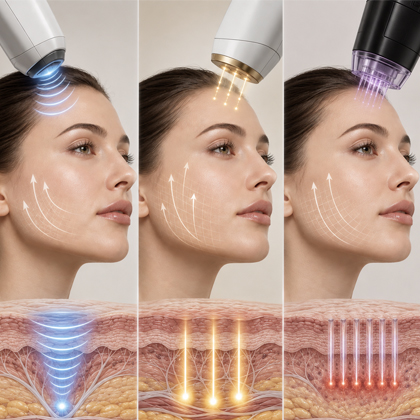
It can be confusing to determine which of the three treatments, HIFU, Ultherapy or Morpheus8, is right for you as all three are designed to tighten and rejuvenate the skin. The difference between HIFU and Ultherapy is that they use focused ultrasound, while Morpheus8 involves radiofrequency energy and microneedling. This will depend on the concern that you wish to address, be it looking for some skin firmness, a skin wrinkle in your jowls, texture, pores, acne scars or volume loss. This comparison gives an insight into how each treatment functions, what results can be achieved and the downtime and if either may be suitable for various skin concerns.
Quick Comparison — HIFU vs Ultherapy vs Morpheus8
| Feature | HIFU | Ultherapy | Morpheus8 |
| Energy | Focused ultrasound | Microfocused ultrasound | Radiofrequency |
| Needles | No | No | Yes |
| Imaging | Device-dependent | Real-time visualization | No ultrasound imaging |
| Primary strength | Lifting/tightening | Lifting/tightening | Texture + tightening |
| Skin surface injury | Minimal | Minimal | Controlled microneedle injury |
| Acne scars | Not primary use | Not primary use | More relevant |
| Pores/texture | Limited | Limited | More relevant |
| Jowls | Mild/moderate cases | Mild/moderate cases | Selected cases |
| Downtime | Usually low | Usually low | More visible downtime |
| Result timing | Gradual | Gradual | Gradual |
| Surgical facelift replacement | No | No | No |
None of these treatments can reproduce the degree of tissue repositioning or excess-skin removal achieved with facelift surgery.
What Is HIFU?
High-intensity focused ultrasound (HIFU) is a technique aimed at creating focused zones of heat below the skin that avoid these surface areas. It can be used for skin tightening, definition of the lower face, jawline improvement, mild reduction of jowls, neck tightening and periorbital/brow treatment.
In a systematic review of 45 clinical trials and cohort studies, researchers found HIFU had measurable effects on tightening, especially in the lower face, neck and periorbital area, but that there is still a lack of complete standardization in how the treatment is performed and more long-term studies are needed.
Does Every HIFU Machine Work the Same?
No, “HIFU” is not a single device; different devices may have different imaging, different depths of penetration in the cartridge, different types of energy delivery, different shot configurations, different quality transducers, and different treatments.
So, when it comes to HIFU vs. Ultherya, one might be thinking of a technology class and the other a specific device.
What Is Ultherapy?
The Ultherapy is a Microfocused Ultrasound with Visualization (MFU-V) system with the branded name Ultherapy. It is a real-time imaging HIFU system that can visualize tissue and treatment depth prior to the delivery of energy, unlike many generic HIFU systems.
What Is Ultherapy PRIME?
The new generation of the Ultherapy platform is called Ultherapy PRIME, and it retains the visualization with ultrasound but provides faster treatment than the older system. But, technology advances are not a substitute for candidate selection, treatment plans or practitioner skill.
Is Ultherapy the Same as HIFU?
While Ultherapy is a type of focused-ultrasound skin lifting procedure, all HIFU treatments are not necessarily Ultherapy. Focused ultrasound is a technology class and Ultherapy is a brand of MFU-V technology.
The difference is that Ultherapy involves the use of live imaging of the skin and regulatory clearance for the use of the device that ca not be extrapolated to all devices that are marketed as HIFU.
What Is Morpheus8?
Morpheus8 is a combination microneedling and radiofrequency energy, which utilizes microneedles to penetrate the skin and deliver controlled RF energy into targeted tissue layers. It is frequently used on the face for fine lines, acne scars, facial rejuvenation, pores, neck rejuvenation and selected laxity.
Unlike HIFU and Ultherapy, the way it works is very different because Morpheus8 is physically penetrating the skin to deliver its energy.
HIFU vs Ultherapy — What’s the Real Difference?
| HIFU | Ultherapy |
| Generic technology category | Specific branded treatment |
| Focused ultrasound | Microfocused ultrasound |
| Imaging varies | Real-time visualization |
| Device quality varies widely | Standardized platform |
| Protocol varies by machine | Platform-specific protocols |
| Cost often lower | Usually premium pricing |
| Evidence varies by device | Larger MFU-V evidence base |
A 2025 systematic review of MFU-V included 42 studies and found evidence supporting facial and neck lifting and tightening, with a generally favorable safety profile. The review also highlighted differences between studies and the need for further well-designed research.
HIFU vs Morpheus8 — Biggest Difference
HIFU is focused on deeper tissue via ultrasound without needles, Morpheus8 is focused on controlled dermal/subdermal injury via microneedles and RF. Lifting and tightening are the primary indications for HIFU.
When tightening is accompanied by concerns like skin texture, pores, or acne scars, Morpheus8 can be more appropriate, but this should be viewed on a case by case basis.
Ultherapy vs Morpheus8
Ultherapy is targeting deeper lifting and Morpheus8 is targeting at dermal level, in the broadness of the skin. For mild brow descent, under chin laxity, neck laxity and lower face tightening, Ultherapy might be more appropriate, while for uneven texture, acne scars, enlarged pores, fine lines and mild laxity, Morpheus8 may be more suitable.
Which Is Better for Skin Tightening?
If the laxity is deeper, it might make more sense to choose HIFU or MFU-V/ Ultherapy, and if the laxity is coupled with bad texture, Morpheus8 might work better. If the laxity is overwhelming, none will likely be sufficient, and surgical intervention may be a more realistic option.
Which is Better for Jowls?
In mild early jowling, Ultherapy and appropriate HIFU may be indicated; in some cases Morpheus8 may be indicated to enhance contour. Significant jowling may require fat compartment descent, energy based techniques that cannot reposition fat such as skin excess and deeper tissue changes that can be corrected by energy based techniques such as facelift surgery.
Which Is Better for the Jawline?
The jawline might be blurred in case of skin laxity, fat under the chin, jowling, weak jawline projection or skeletal structure. Depending on the signs of laxity, Morpheus8 might be appropriate for skin texture or mild laxity and for fat related concerns, it may be necessary to use another treatment.
Which Is Better for the Neck?
There are examples that support the use of HIFU and Ultherapy for lower face and Neck tightening, and examples of the use of Ultherapy for lifting neck and under chin skin. While Morpheus8 may help with some neck issues such as texture or fine lines and crepey skin, there is no one size fits all treatment that works best.
Which Is Better for Acne Scars?
In general, Morpheus8 is the more appropriate option as it offers the benefit of combining the Microneedling technique with RF induced dermal remodeling. HIFU and Ultherapy are not the initial treatment methods for Acne scars or resurfacing.
Which Is Better for Large Pores and Skin Texture?
Morpheus8 is more relevant as it works directly on the dermis via microneedling and RF. Both HIFU and Ultherapy are not surface resurfacing, and should not be sold as any kind of major pore reduction treatments.
Which Is Better for Fine Lines?
It depends on location and purpose of the lines.
Texture-related fine lines: Morpheus8 may be more relevant.
Lines related to laxity: Ultrasound lifting may indirectly improve appearance.
Expression lines: None of these may be the main solution; botulinum toxin could be more relevant depending on anatomy.
Which Is Better for a Double Chin?
A double chin can be caused by any of the following:
- Submental fat
- Skin laxity
- Both
However, if skin looseness is the main concern, ultrasound tightening could be helpful to bring the definition back.
Treatment may be best directed at fat if it predominates.
Do not treat HIFU, Ultherapy or Morpheus8 as guaranteed fat removal substitutes.
A Double Chin Treatment plan should identify whether the primary issue involves fat, loose skin or both.
Which Treatment Goes Deeper?
Beware of straightforward depth comparisons, since the settings on different devices will differ.
Conceptually, HIFU and Ultherapy create focal thermal zones at specific depths, including deeper connective tissue levels.
Ultherapy uses targeted treatment depths together with visualization to identify the intended tissue layer.
Morpheus8 uses adjustable Microneedle penetration to deliver RF energy into dermal and subdermal tissue.
However “deeper” does not automatically mean “better.”
The correct depth depends on the tissue you actually want to treat.
Which Treatment Stimulates More Collagen?
HIFU: Thermal Coagulation in focussed ultrasound points.
Ultherapy: Microfocused ultrasound thermal zones.
Morpheus8: The combination of microneedle injury and an RF thermal effect.
Biological response may vary based on:
- Energy
- Depth
- Device
- Tissue
- Treatment protocol
Which Treatment Gives Faster Results?
HIFU / Ultherapy: The initial tightening may be visible but will take a while to become apparent as the tissue remodel, the manufacturer of Ultherapy has said that it will gradually improve over the years and can last for up to a year or longer in some patients.
Morpheus8: Texture and tightening will also gradually improve as healing and remodeling is ongoing. None of these treatments should be sold as a ‘facelift on a table.’
Which Has More Downtime?
Ultherapy / HIFU: Redness, swelling, tenderness and discomfort may occur but generally they have less visible surface downtime as they do not puncture the skin.
Morpheus8: The insertion of Microneedles into the skin creates a more visible short term recovery experience as there may be some temporary redness, swelling, pinpoint crusting and sensitivity.
Which Treatment Hurts More?
No universal pain ranking; depends on treatment intensity, area, device, number of passes, anesthetic protocol and patient sensitivity. Ultherapy can give a deeper feel to the treatment and Morpheus8 gives needle and thermal sensations.
Which Has the Most Evidence?
HIFU: Broad category, many devices; 2025 systematic review revealed 45 clinical studies/cohorts with clinically relevant skin tightening results, noting that there was variability in protocols.
Ultherapy/MFU-V: A more standardized branded platform with focused research, including a 2025 systematic review/meta analysis of the efficacy and safety of MFU-V.
Morpheus8 / RF Microneedling: RF Microneedling is a technology category supported by evidence yet it is important to note that results of RF microneedling studies cannot be directly translated to a Morpheus8 treatment.
Which Treatment Is Safer?
Each of these treatments has potential problems.
HIFU Risks
Can cause pain, redness, swelling, tenderness, numbness, temporary nerve symptoms and if not used properly, burns and tissue injury.
Ultherapy Risks
Reported clinical trial effects include transient nerve effects, pain, swelling and redness.
Morpheus8 Risks
May result in pain, swelling, redness, crusting, infection, pigment change, burn, scarring and chronic inflammation depending on depth, energy and technique.
Which Is Better for Darker Skin Tones?
Ultrasound based technologies do nott target epidermal pigment so this means that they can be applied to various skin tones, and Ultherapy explicitly notes that it is suitable across skin tones. When done correctly, RF microneedling may be used on a wide variety of skin types.
But there are still factors to consider when selecting and planning treatment such as energy, aftercare and the pigmentation history of the area to be treated after the needling was performed.
How Many Sessions Are Needed?
Ultherapy: This may be marketed as one or few sessions, but could be repeated in cases where results vary from person to person and/or aging.
Generic HIFU: Session requirements vary widely between devices and providers and
Morpheus8: Frequently performed in a series based on scarring, texture, laxity and energy settings.
How Long Do Results Last?
Ultherapy: The manufacturer states that in some patients, it can last for a year or more,
HIFU: Results may vary depending on the device, the treatment parameters and the patient.
Morpheus8: The results vary according to the age, skin quality, treatment course and maintenance. When it comes to results, they’re temporary as natural skin ageing takes place.
HIFU vs Ultherapy vs Morpheus8 for Different Concerns
| Main Concern | More Logical Starting Point |
| Mild lower-face laxity | HIFU / Ultherapy |
| Mild jowls | HIFU / Ultherapy |
| Neck laxity | HIFU / Ultherapy |
| Brow lifting | Ultherapy / selected HIFU |
| Acne scars | Morpheus8 |
| Large pores | Morpheus8 |
| Rough texture | Morpheus8 |
| Fine textural lines | Morpheus8 |
| Texture + mild laxity | Morpheus8 |
| Deep lifting without needles | Ultherapy / HIFU |
| Severe jowls | Surgical assessment |
| Major loose neck skin | Surgical assessment |
| Significant double chin fat | Fat-directed assessment |
This is a simplified framework, not a prescription.
Can HIFU and Morpheus8 Be Combined?
Combination of HIFU and Morpheus8 might be possible as both work on different layers of the tissue, HIFU on deeper layers, and Morpheus8 on dermal texture and remodeling. The planning of the treatment intervals, the planning of inflammation etc. is a very important aspect of combination treatment, as is energy setting, facial fat thickness and skin thickness.
Can Ultherapy and Morpheus8 Be Combined?
In certain cases, Ultherapy can even offer a more significant lift through ultrasound technology and Morpheus8 can help with improving the texture and tightening of the skin. But the two together should not be the standard add-on treatment, but rather be offered in response to individual treatment requirements.
Can These Treatments Cause Facial Fat Loss?
Energy based treatments that are applied at the wrong energy level, incorrect anatomical location or at the wrong depth may impact unwanted anatomical layers. Those with already thin faces will require special facial planning; facial fat reduction should not be seen as a standard skin tightening objective.
Which Is Best for Someone With a Thin Face?
It is important to avoid excessive tension, focusing on the fat volume in the face, skin thickness, bone structure and laxity. The aim is to firm the skin up without compromising the volume of the face.
Which Is Best After Weight Loss?
The degree of laxity will vary. If your skin is just hanging around slightly, an energy based device will tighten it, but if it is hanging, a lot of it, you need to trim it back and if the skin is hanging it is too heavy to be energy based.
This is especially important following GLP-1 related weight reduction, bariatric weight reduction or weight loss that has caused significant weight loss including concerns such as Ozempic Face and Ozempic Body.
When Is a Facelift Better Than HIFU, Ultherapy or Morpheus8?
A surgical assessment becomes more relevant with:
- Major jowls
- Significant skin excess
- Advanced neck laxity
- Deep tissue descent
- Strong platysmal bands
- Substantial lower face ageing
These devices can create modest non-surgical improvements, but they cannot:
- Remove excess skin
- Surgically reposition SMAS
- Reconstruct the neck
- Produce facelift level correction
A non surgical facelift will enhance selected signs of ageing without the surgical corrections of a facelift.
Which Treatment Should You Choose?
Choose HIFU when: You have mild to moderate laxity and do not want any needles used for the treatment.
Consider Ultherapy when: You have concerns in the brow, neck, or under chin area and want microfocused ultrasound with real time visualization.
Consider Morpheus8 when: your goals are to improve the texture, treat acne scars, reduce enlarged pores and fine lines and mild tightening.
Think otherwise when: The primary issue is fat deposits which are large, there is a significant deficiency of volume, the jowls are advanced, and there is surplus skin.
The Better Question Isn’t “Which Machine Is Best?”
The better question is: What anatomical issue is it that you’re looking to fix? The cause could be skin laxity, tissue descent, poor skin texture, acne scars, enlarged pores, fat, loss of volume, muscle activity or skeletal structure.
Next determine the treatment modality based on the problem encountered. This is much more powerful than ranking machines.
Questions to Ask Before Choosing a Treatment
- What is actually causing my concern?
- Is it skin laxity, fat, volume loss or texture?
- Am I a good candidate for energy-based tightening?
- Is my skin too lax for a non-surgical procedure?
- Which HIFU device do you use?
- Does the HIFU device provide imaging?
- Is this genuine Ultherapy?
- Will real time visualization be used?
- Which Morpheus8 depth/settings are planned?
- Is my facial fat at risk of unwanted volume loss?
- What degree of improvement is realistic?
- How many sessions will I need?
- When should results appear?
- What side effects are common?
- What serious complications are possible?
- What is the expected downtime?
- Could another technology suit me better?
- Could I actually need filler instead?
- Would surgery provide a more predictable result?
- When will the treatment result be reviewed?
FAQs
What is the difference between HIFU, Ultherapy and Morpheus8?
HIFU and Ultherapy utilize focused ultrasound for tightening; Morpheus8 utilizes RF Microneedling for tightening, texture and remodeling.
Is Ultherapy the same as HIFU?
No, Ultherapy is a brand of MFU-V and HIFU is a category of focused-ultrasound technology.
Is Ultherapy better than HIFU?
No, it depends on the device, treatment plan, practitioner and your concern.
Is Morpheus8 better than HIFU?
Morpheus8 can be used for texture, pores and acne scars and HIFU may work well for lifting and tightening.
Is Morpheus8 better than Ultherapy?
There is no one right or wrong because they each have different skin focused and tissue layers.
Which treatment tightens skin the most?
The HIFU and Ultherapy could be more applicable for lifting, whilst Morpheus8 is more applicable for tightening with texture remodeling.
Which is better for jowls?
Mild jowls might be appropriate for Ultherapy, or for more severe jowls, a surgical evaluation may be required.
Which is better for the jawline?
HIFU or Ultherapy can be used for laxity issues with the jaw line, while Morpheus8 can be utilized if texture is also an issue.
Which is better for the neck?
If neck laxity is a problem, then HIFU or Ultherapy could be right and if fine lines and texture are also a concern, Morpheus8 might be the answer.
Which is better for a double chin?
The best choice will depend on whether the double chin is due to skin laxity, submental fat or both.
Which is better for acne scars?
Morpheus8 is typically the more pertinent choice as it integrates microneedling and RF-based dermal remodeling.
Which is better for large pores?
Morpheus8 is actually more applicable as it treats dermal texture and pore-related issues.
Which is better for wrinkles?
Morpheus8 can be used for lines that are related to the texture, and ultrasound treatments can be used for lines related to skin laxity.
Which stimulates more collagen?
All three induce remodeling, though their collagen effect differs based on energy, depth, device, tissue and treatment protocol.
Which treatment goes deeper?
Unlike HIFU and Ultherapy, which target specific depths, Morpheus8 offers RF at adjustable depths of microneedles.
Which treatment hurts more?
Discomfort is variable, ultrasound tends to cause deeper discomfort, while Morpheus8 causes discomfort in the needle related and thermal aspects.
Which has less downtime?
Since they do not puncture the skin, HIFU and Ultherapy typically are less noticeable than Morpheus8.
Which treatment works faster?
All three have slow effects, but there might be some initial tightening before the remodeling process becomes apparent.
How many HIFU sessions do you need?
This is dependent on device, treatment area, protocol and patient response.
How many Ultherapy sessions do you need?
While Ultherapy is presented as a one-session procedure, retreatment might be necessary depending on the person’s reaction to the treatment and ageing.
How many Morpheus8 sessions do you need?
This can depend on the concern like acne scars, texture, laxity and treatment settings.
How long do results last?
The results are dependent on the treatment, the quality of the skin, the ageing process, the treatment parameters, and maintenance.
Can HIFU cause facial fat loss?
Facial-fat preservation is important because the inappropriate placement of depth, energy, or treatment can impact unwanted tissues.
Can Morpheus8 cause facial fat loss?
Aggressive RF Microneedling settings can impact deeper layers, so it is paramount to take care of the depth and energy you select.
Is Ultherapy safe for thin faces?
Care must be taken with the assessment and conservative treatment planning for the treatment of thin faces in order to prevent unnecessary soft-tissue changes.
Can HIFU and Morpheus8 be combined?
In specific instances, they may be fused together, as both the tightening and dermal remodeling can be addressed.
Can Ultherapy and Morpheus8 be combined?
In some instances they can be used together, but not everyone will be able to use both together.
Which treatment is best after weight loss?
The laxity of mild degrees may respond to energy treatment and excess skin may need to be evaluated surgically.
Which is the best alternative to a facelift?
Non surgical improvement can be achieved with HIFU, Ultherapy or Morpheus8, but not with any of these treatments does the tissue repositioning achieved in a facelift.
When should I get a facelift instead?
A facelift becomes more relevant with major jowls, great excess skin, advanced neck laxity or a great tissue descent.