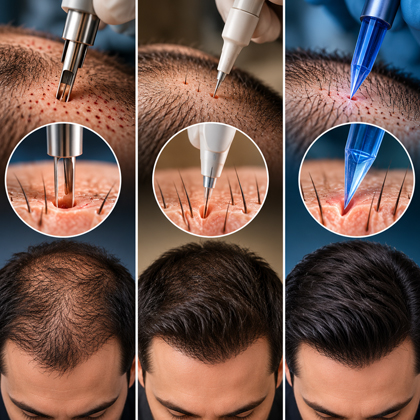
Choosing between FUE vs DHI vs Sapphire FUE hair transplant can seem confusing, especially when clinics present them as three completely different procedures. However, they are not. FUE primarily relates to graft extraction, DHI primarily relates to an approach to grafting, and Sapphire FUE primarily to the use of sapphire blades in creating the recipient site. If you know these differences you can make a better comparison of technique based on the entire treatment process, rather than just the name.
FUE vs DHI vs Sapphire FUE — Quick Comparison
| Feature | FUE | DHI | Sapphire FUE |
| What it mainly describes | Donor harvesting | Implantation technique/workflow | Recipient site blade material + FUE harvesting |
| Donor graft removal | FUE | Usually FUE | FUE |
| Punch used for harvesting | Yes | Usually yes | Yes |
| Recipient sites | Pre made incisions or other implantation methods | Often uses an implanter | Usually sapphire blade incisions |
| Implantation | Forceps or implanter | Implanter | Usually implantation into sapphire created channels |
| Recognized as a separate transplant method by ISHRS? | Yes, as a donor-harvesting method | No | No |
| Linear FUT scar | No | No if grafts come from FUE | No |
| Small donor scars possible | Yes | Yes | Yes |
| Best for everyone? | No | No | No |
The major misconception involves comparing these terms as three completely separate operations. DHI and Sapphire FUE generally modify the implantation or recipient-site stages of an FUE based transplant rather than replacing FUE donor harvesting.
What Is FUE Hair Transplant?
FUE is the abbreviation of Follicular Unit Excision.
In FUE (Follicular Unit Excision), the follicular units are extracted one by one from the donor area with the help of small punches on the scalp.
According to the International Society of Hair Restoration Surgery, FUE is the removal of natural (follicular) units one by one, typically one to four hairs per unit depending on the technique used.
The typical FUE procedure goes through the following steps:
- Donor assessment
- Hairline and recipient area planning.
- Trimming or shaving of donors as necessary
- Local anesthesia
- Use punching tool to form incisions around individual hair follicles
- Graft extraction
- Graft inspection and storage are done.
- Recipient-site preparation
- Graft implantation
Why FUE Does Not Tell You How the Grafts Are Implanted
FUE is not a way of implanting grafts, it is a technique of graft harvesting. Once the FUE extraction is completed, the surgeons may insert the FUE grafts with the forceps into the pre made incisions, stick and place the grafts or use dull or sharp implanters.
This means FUE vs DHI is not a technically clean “method A vs method B” comparison; a more accurate comparison is FUE harvesting with conventional implantation vs FUE harvesting with implanter-based implantation.
What is DHI Hair Transplant?
The term DHI (Direct Hair Implantation) refers to the way in which the hair grafts are placed in the clinic using an implantation pen or device. The implanter keeps the follicular-unit graft in a channel until it’s pushed into the scalp by a plunger, according to the International Society of Hair Restoration Surgery (ISHRS).
Two Broad Implanter Types:
- Dull Implanters: Use for insertion of grafts into existing incisions.
- Sharp Implanters: Make a cut in the skin of the recipient at the same time that the graft is inserted.
The ISHRS notes that sharp implanters create skin incisions, so their use constitutes a surgical step.
Is DHI Really Different From FUE?
In short, no – typically not during harvest. A procedure known as DHI typically includes FUE harvesting and implanter use and is frequently performed under the same procedure, which could result in a patient getting FUE extraction and DHI style implantation in one procedure. According to ISHRS, DHI cannot be a product or a separate hair transplant technique.
What Is Sapphire FUE?
Sapphire FUE typically refers to a procedure being performed which uses sapphire blades to make the channels for the recipient site rather than steel blades. It is correct to call it FUE graft harvesting, as the donor harvesting is still made with FUE, and sapphire blade recipient incisions and graft implantation follow.
The ISHRS identifies “Sapphire FUE” among marketing terms that do not form part of its recognized FUE terminology, so it should not be presented as an entirely new generation of transplantation.
What Is the Sapphire Blade Actually Used For?
The sapphire is not used to remove follicles, but primarily to create a recipient site. Surgeon creates small channels or incisions which affect direction, angle, distribution, spacing and density of grafts; the surgeon then places the grafts into these incisions. This is important as it is because the extraction process of FUE does not fundamentally change with sapphire blades.
Is Sapphire FUE Better Than Traditional FUE?
Not necessarily. Recently published prospective observational study with 1,000 patients found better graft-survival rates in its Sapphire-blade group compared to its steel blade group, but the observational design does not prove that Sapphire FUE is always better.
Other factors that influence results include the diagnosis of hair loss, the quality of the donor hair, the skills of the punch, the handling of the grafts, the design of the recipient area, the placement of the grafts, surgeon experience and post surgery care. The study is, therefore, not a proof of the superior scientific value of Sapphire FUE compared to traditional FUE but rather emerging evidence.
Steel Blades vs Sapphire Blades
| Factor | Steel Blade | Sapphire Blade |
| Used for | Recipient channels | Recipient channels |
| Donor harvesting method | Separate | Separate |
| Material | Surgical steel | Sapphire |
| Control direction and angle | Through surgeon’s incision design | Through surgeon’s incision design |
| Automatically increases survival? | No | Not proven universally |
| Makes the procedure scarless? | No | No |
| Replaces surgical skill? | No | No |
The material of the blade represents only one variable in recipient site creation.
FUE vs DHI — Key Difference
While FUE will tell you how the grafts are harvested from the donor area, DHI typically refers to the method of implanting the grafts into the recipient area. Thus for a patient, FUE + DHI can be performed in the same treatment, which is the most crucial terminology explanation for the page.
FUE vs Sapphire FUE — Key Difference
Both generally employ harvesting with FUE and the only difference is in the creation of the recipient sites. Conventional FUE can use steel blades, needles or other surgical instruments and Sapphire FUE can use sapphire blades to create channels for the recipient, so the process of taking out the grafts can basically be the same.
DHI vs Sapphire FUE — Key Difference
The comparison relates primarily to the implantation process. Sapphire FUE typically uses pre-made recipient channels, and DHI with sharp implanters can be done with the creation of the recipient incision and the insertion of the hair graft all in one process; forceps and implanters are recognized as a method of implantation, but DHI is not a separate method of harvesting.
Which Gives Better Hair Density?
Higher density is not guaranteed for any technique because it is determined by the type of grafts available, donor density, hair calibre, hair per follicular unit, recipient site spacing, scalp vascularity, existing hair, hair loss pattern and the surgeon’s planning. In certain cases, the implanting surgeon may be able to help with exact positioning but the ultimate objective is safe, attractive density, with maintenance of graft survival and scalp blood supply.
Which Is Better for Hairline Design?
The natural hairline results are mainly based on the shape of the hairline, temporal recession, single hair graft selection, direction and angle of the graft, irregularity of the hairline and density transition. No device or blade will set up a natural hairline; correct follicular-unit graft angulation, orientation and positioning are natural outcomes, according to the ISHRS.
Which Gives Better Graft Survival?
To ensure graft survival it is important that all steps are completed: excision, extraction, handling, storage, recipient-site creation, implantation and healing. Grafts can be affected by transection, crushing, dehydration, excessive handling, poor storage, and recipient trauma and implanters may minimize handling as the follicular bulb does not require direct handling by the forceps during implantation, but this does not mean that all DHI procedures yield a higher implant survival rate than regular implantation procedures.
Which Technique Leaves Less Scarring?
All the FUE procedures can leave small donor scars, such as regular FUE, DHI (during FUE harvesting) and Sapphire FUE. The ISHRS expressly disclaims making the claim that FUE is “scarless,” “no scars,” “no incision,” or “no cutting” as these terms are misleading even with proper technique and hair style, small round scars will remain where grafts are removed.
Which Has Faster Healing?
Punch size, number of grafts, trauma to recipient sites, technique of the punch, the amount of time the surgery takes, patient factors and after care are all important in determining healing and recovery after the FUE, DHI, or Sapphire FUE label. Any fixed claims like “Sapphire heals in 3 days” or “DHI heals twice as fast” are not considered as a standard time frame, as there is no such standard recovery time based on these marketing claims alone.
Which Causes Less Bleeding?
Both FUE and DHI use small recipient site incisions but neither technique can guarantee a bloodless procedure. Creating recipient sites can disrupt small blood vessels, so some bleeding remains possible. The amount varies with the site size, incision density, depth, scalp vascularity, medications and surgical technique. Modern hair transplantation uses small recipient incisions to limit tissue trauma, but no surgical hair transplant should be marketed as completely bloodless.
Which Causes Less Pain?
There is no single option that is consistently less painful, as pain and discomfort can vary with local anesthesia administration, surgery length, donor extraction, recipient site creation, patient sensitivity, and postoperative swelling. Claims such as “DHI is painless” or “Sapphire FUE is pain free” should be avoided because the ISHRS identifies “pain free” as misleading advertising.
Which Requires Shaving?
Shaving is not a part of FUE, DHI or Sapphire FUE. ISHRS guidance suggests that the methods used for donor shaving, recipient shaving and implantation should be distinguished, and it is suggested that all of these can occur: fully shaven, donor shaven, recipient-shaven, partial shave and unshaven/long hair FUE; a 2026 review also covers long-hair FUE as an emerging choice for certain androgenetic alopecia (AGA) recipients.
Which Is Better for Women?
Not all women will be ideal candidates for DHI, as women’s transplants may address a widening part, to restore thinning hair at the top of the head, to fill in thinning spots, to help restore the hairline or to treat what is known as traction alopecia. Important factors include donor density, native-hair preservation, implantation among existing hairs, limited shaving, and graft distribution, so DHI-style implantation or long hair FUE may suit selected cases, but diagnosis and donor suitability matter more than the technique name.
Which Is Better for Beard Hair Transplant?
Acute exit angles, direction, density transition, single hair graft selection, facial symmetry, and donor hair characteristics are all considerations that should be given to beard transplants. It’s important to note that the priority should still be on exact positioning of the grafts and facial-hair design and not necessarily going for DHI or Sapphire FUE.
Which Is Better for Crown Hair Transplant?
Crown transplantation is a well planned procedure that considers the whorl pattern, direction, the size of the crown, the availability of grafts, and the likelihood of hair loss. The number of grafts that the crown consumes can be important, particularly in the context of donor management, rather than whether the recipient utilizes sapphire blades or whether grafts are introduced to the recipient via an implanter.
Which Is Better for High Graft Counts?
There is no universal answer, because high-graft procedures depend on donor capacity, extraction safety, surgical duration, team experience, graft storage time, and scalp-coverage goals. More grafts do not automatically mean a better result, and the ISHRS specifically warns against misleading claims such as “unlimited grafts.”
FUE vs DHI vs Sapphire FUE Recovery
First Few Days
Redness, swelling, tenderness, crusting and small donor extraction sites may occur.
Around the First 1–2 Weeks
Typical healing of the recipient crusting starts to improve following a postoperative protocol.
Following Weeks
The transplanted hair strands could fall out as they go through the regular hair growth cycle.
Following Months
With the follicles growing, new hair will grow progressively over time, and the hairs may require a much longer time to mature, depending on the patient and hair area.
Does DHI Reduce Graft Handling?
Potentially. An advantage of implanters may be that the implantation of the follicular bulb is not directly handled by the forceps, thus decreasing the handling trauma. This is a potential handling advantage, however and not an assurance of clinically better graft survival in all patients.
Does Sapphire FUE Create Smaller Channels?
Some clinics advertise that their sapphire blades are sharper, cause smaller incisions in the recipient and are more precise. However, channel size is also influenced by the size of the blade, the size of the graft, the surgeon’s choice and the anatomy of the recipient. The sapphire blades do not automatically fall into the category of making smaller cuts than any steel blade, however.
Is DHI More Advanced Than FUE?
No, DHI is not a newer method for replacement of FUE as they are different stages of transplantation. “Advanced” is often a marketing term and doesn’t necessarily mean the procedure is DHI, or even a FUE procedure, as the donor follicular unit excision (or FUE) and donor hair implantation with an implanter (or DHI) are often interchangeably used.
Is Sapphire FUE More Advanced Than FUE?
No, Sapphire FUE is not FUE with sapphire instruments creation of the recipient site. It does not mean “3rd generation FUE”, “4th generation FUE” or “latest generation FUE” either, as there is no medical standardization for these promotions and ISHRS states that many of the FUE labels in the promotion are not standardized.
Which Is More Expensive?
Conventional FUE may provide the baseline surgical price, while DHI may cost more because of the implanter workflow, staffing, selected procedural time and clinic positioning.
Sapphire FUE may also carry a premium because of sapphire blades, premium branding, or clinic specific packages but price does not prove clinical superiority.
The better comparison is:
total grafts + surgeon involvement + surgical plan + implantation strategy + aftercare + price
What Actually Matters More Than FUE vs DHI vs Sapphire?
The technique label is not as important as the whole treatment plan:
- Diagnosis: What type of hair loss is present?
- Donor Capacity: Number of grafts that the surgeon can safely remove?
- Hairline Design: Where to start the hair transplant?
- Graft quality: What is the number of foliar units available?
- Graft Handling: What does the team do to prevent grafts from drying out and being damaged?
- Recipient-Site Planning: What is done to control angle, direction, density and distribution?
- Surgeon Involvement: Who carries out the surgical portions?
The ISHRS has consistently reminded patients that they need to check on who’s doing the procedure, as the delegation of surgical responsibilities to unlicensed technicians is still a big worry in the hair transplant market.
FUE vs DHI vs Sapphire FUE — Which One Should You Choose?
If you are considering FUE, DHI, and Sapphire FUE, there is no clear winner as there are many factors to consider including your hair loss, donor supply, graft needs, and surgeon’s approach.
Consider conventional FUE-based transplantation when:
- The standard FUE suits are designed for your donor site
- The number one concern is still good donor management
- The pre-made recipient channels are appropriate to your treatment plan
Consider implanter-based/DHI-style placement when:
- Accurate placement within existing hair could be beneficial to your case
- Your surgeon prefers to place the implant
- The recipient site plan is appropriate for this
Consider Sapphire FUE when:
- Your surgeon would like to use sapphire blades for the recipient site
- The size of the blade and the incision is appropriate for your grafts
- Sapphire-blade recipient site creation forms part of a well planned FUE transplant
The conclusion: Select surgery based on surgical plan & experienced surgeon, not just a marketing tag.
Questions to Ask Before Choosing FUE, DHI or Sapphire FUE
Before committing to treatment, ask:
- What is my hair loss diagnosis?
- Am I a suitable hair transplant candidate?
- How many grafts do I actually need?
- How many grafts can you safely take from my donor area?
- Are you using FUE to harvest my grafts?
- What punch size will you use?
- Who performs the donor incisions?
- Who extracts the grafts?
- Who creates my recipient sites?
- Who implants my grafts?
- If you call the procedure DHI, what exactly does DHI mean at your clinic?
- Which implanter do you use?
- Does the implanter create the recipient site or only place the graft?
- If you recommend Sapphire FUE, what specifically changes compared with conventional FUE?
- Why do sapphire blades suit my case?
- How do you store the grafts before implantation?
- What donor scarring should I realistically expect?
- How will you prevent overharvesting?
- What happens if my native hair continues thinning?
- What does the quoted treatment price include?
These questions give you much more useful information than simply asking, “Which technique is the latest?”
FAQs
What is the difference between FUE, DHI and Sapphire FUE?
FUE refers to graft extraction, DHI is direct implantation using an implanter pen and Sapphire FUE involves sapphire blades when creating the recipient sites.
Is DHI actually a type of FUE?
Yes! FUE is a common method of graft collection for DHI but the method of implanting the graft is what sets them apart.
Is Sapphire FUE a different hair transplant technique?
No, Sapphire FUE is a type of FUE, which uses sapphire blades to create recipient sites.
Is DHI better than FUE?
There is no single best method as it depends on your hair loss, the number of
grafts you need and your treatment objectives.
Is Sapphire FUE better than normal FUE?
Sapphire FUE can help to create a more precise recipient site area but it does not guarantee optimal results for every patient.
Is DHI better than Sapphire FUE?
There is no universal benefit either, both of which work well for certain surgical procedures and patients.
Which hair transplant technique gives the best density?
The technique name is the least important factor in density; other factors such as donor supply, graft placement, hair characteristics and surgical planning are most important.
Which has the best graft survival?
If the extraction, storage, implantation and aftercare is done properly by a qualified team, all three can successfully achieve a high percentage of graft survival.
Which has the fastest recovery?
The recovery pattern with FUE, DHI and Sapphire FUE is similar with individual healing varying.
Which causes less pain?
All three methods cause minimal pain, as local anaesthetic is used.
Which leaves fewer scars?
All three are less invasive techniques that generally do not involve a linear scar like FUT does.
Does DHI leave scars?
DHI can leave tiny, minimally visible marks where grafts enter the recipient area, while FUE extraction also creates small donor area marks.
Does Sapphire FUE leave scars?
Sapphire FUE causes scant extraction and implantation marks that are typically hard to see when they heal.
Which method is better for the hairline?
While DHI can be controlled around the hair line, the surgeon’s design and technique is more important than the label.
Which is better for women?
The ideal choice for females will rely on the reason and pattern of hair loss, donor density, and the possibility of shaving.
Which is better for beard transplantation?
FUE and DHI are suitable options for beard transplants, depending on the specific beard design and the type of grafts.
Which method is better for crown restoration?
The restoration of the crown can be achieved with FUE, DHI or Sapphire FUE with the best option depending on the number of donor grafts available and the size of the thinning area.
Can DHI be performed after FUE extraction?
Yes, DHI can follow FUE extraction as DHI is mainly the technique of transplanting the grafts into the recipient area.
Does Sapphire FUE use a sapphire punch?
No, Sapphire FUE normally involves sapphire blades to break the skin for recipient sites and their grafts are normally extracted with a separate FUE punch.
What is a DHI implanter pen?
A DHI implanter pen is a hollow needle like device with a graft attached to it that the surgeon can implant directly into the area that is being implanted.
Are sapphire blades better than steel blades?
The Sapphire blades can offer accurate incisions at the recipient site; however, these will not ensure superior outcomes as compared to correct use of steel blades.
Does DHI damage fewer grafts?
The number of times DHI is handled may be limited, however, graft survival is dependent on the whole procedure and not only the pen used by the implanter.
Does Sapphire FUE heal faster?
Sapphire FUE can recover smoothly but the recovery time will differ from patient to patient and is not always quicker than regular FUE.
Which technique costs more?
The cost of DHI is also generally higher than the regular FUE, and the pricing of Sapphire FUE will vary from one clinic to another, depending on the number of grafts, the surgeon, and the treatment plan.
Is DHI worth the extra cost?
However, if the benefits of DHI’s implantation method are greater than your individual hair restoration requirement, then it is a good addition to the price.
Is Sapphire FUE worth the extra cost?
Although it might be beneficial for certain patients, the added expense should be justified by proven clinical benefits, not just the technology’s name.
Can FUE be done without shaving?
Yes, there are partial or no shave options available with selected FUE procedures, but this will depend on how long your hair is and what treatment is being offered.
Which hair transplant technique should I choose?
Choose based on your hair loss pattern, donor supply, desired density, hairline goals, and your surgeon’s recommended approach rather than the technique name alone.