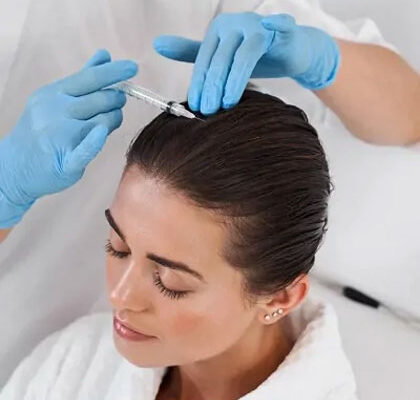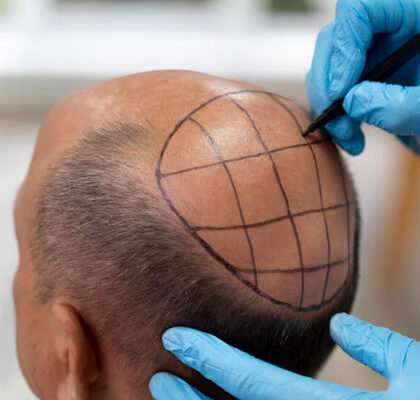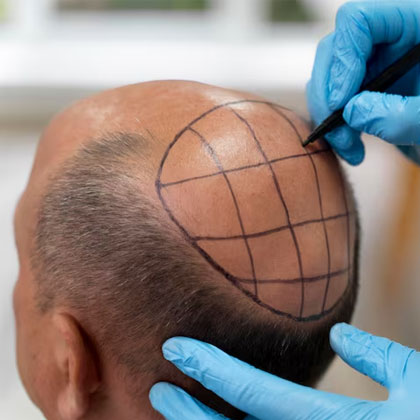
Hair loss occurs due to a variety of factors including genetics, hormonal fluctuations, stress, alopecia, poor diet or sleeping habits which all can cause gradual deterioration of hair follicle activity. As this occurs, the hairline gradually recedes, the top of the head thins, and overall density is lost creating an obvious unbalance in the scalp. While shampoos, oils and home remedy products may contribute to better hair health generally, they are unable to reactivate dormant follicle activity or restore severe baldness once it has occurred. Vow Clinic Dubai uses state of the art hair transplant procedures which relocate active hair follicles from areas where you have excess hair and place them into areas with limited or no hair. These relocation techniques include FUE hair transplant, DHI hair transplant and FUT. Our specialists then carefully recreate a hairline that appears normal, enhance scalp coverage and increase density using these relocated follicles.
What Is a Hair Transplant?
A Hair transplant is a minimally invasive procedure that involves taking hair roots from donor area (the back part of your head) and transferring those roots to thinning or balding areas. Doctors design it around natural growth patterns, so the new hair blends seamlessly with existing strands.
It targets key areas that include:
- The front of your head
- The back of your head (Crown)
- Temples
- Where your hair is receding
What Causes Hair Loss?
There isn’t just one reason that causes people to lose their hair. There are many factors that make cause hair loss and they all build up over time.
Some of these include:
-
Male Pattern Baldness
This is the most common cause. It follows a genetic pattern when your hair thins at your temples and crown as you age.
-
Female Hair Loss
Unlike men who typically develop thinning in the front of their heads, women tend to thin out across the top of their head.
-
Genetics
You’re going to be more likely to go bald if it runs in the family
-
Hormonal Changes
During pregnancy, menopause and during certain times of life, individuals may experience hormone changes which may cause them to shed hair.
-
Stress & lifestyle
Stress, lack of restful sleep, poor diet and overall bad habits can lead to weak hair follicles.
Other related conditions include:
- Alopecia
- Thin hair
- Receding hairline
Who Is a Good Candidate for Hair Transplant?
Not all people require surgery right away.
You’re an ideal candidate if you have:
- A pattern of hair loss that doesn’t worsen over time
- Good donor site at the back of the head
- Realistic expectations
- Healthy scalp condition
Both those with early balding and advanced balding may benefit, depending upon the availability of grafts.
Hair Transplant Techniques
Current clinics in Dubai use cutting edge techniques to minimize scar tissue and natural results.
FUE Hair Transplant
FUE (Follicular Unit Extraction) is an extraction method that involves picking up individual hair follicles and then transplanting them into the affected area.
- No sign of a linear scar.
- Faster healing
- Natural density results
DHI Hair Transplant
DHI (Direct Hair Implantation) involves the direct implantation of follicles using a special implanter pen.
- Higher precision
- Enhanced control of angle and direction
- Ideal for hairline design
FUT Hair Transplant
FUT (Follicular Unit Transplantation) will harvest grafts from a strip of scalp.
- Ideal for bigger hair loss patches
- More grafts in one session
- Leaves a linear scar
The different methods are effective in different ways for varying levels of hair loss and client objectives.
FUE vs DHI vs FUT
FUE
- Most popular option
- Balanced cost and results
- Minimal downtime
DHI
- Ideal at the point of ultimate precision hairline work
- More expensive than FUE
- Denser implantation possible
FUT
- The most suitable option for maximum graft extraction.
- Longer recovery
- Visible strip scar risk
Specialists select the technique depending on:
- Donor hair strength
- Baldness level
- Desired density
- Budget
Hair Transplant Procedure
- Consultation and Planning: The process begins with a detailed consultation where the specialist examines your scalp, donor area, hairline design, and pattern of hair loss. The doctor discusses your goals and determines whether FUE Hair Transplant, DHI Hair Transplant, or FUT suits your condition best. A personalised treatment plan gets created based on graft requirement and natural hair density goals.
- Anesthesia: Local anesthesia gets applied to the donor and recipient areas to ensure a completely comfortable procedure. You stay awake during the treatment, but you feel minimal to no discomfort throughout the process.
- Donor Area Extraction: Healthy hair follicles get carefully extracted from the donor area, usually the back or sides of the scalp where hair growth remains strong and permanent. In FUE, follicles get extracted individually, while in FUT, a strip of scalp gets removed and dissected into grafts.
- Graft Preparation: The extracted follicles are then sorted and prepared under high magnification. Each graft gets preserved carefully to maintain its survival rate and ensure strong future growth.
- Channel Creation (Recipient Area Design): The surgeon creates tiny incisions in the thinning or bald areas such as the hairline, crown, or temples. The angle, direction, and depth get carefully controlled to match your natural hair growth pattern.
- Implantation of Hair Follicles: Prepared grafts get implanted into the recipient area. In DHI Hair Transplant, a special implanter pen allows direct placement for higher precision and density control, especially in the frontal hairline.
- Final Cleaning and Dressing: Once implantation completes, the scalp gets cleaned and treated with protective care. The clinic provides aftercare instructions to support healing, reduce swelling, and promote proper graft survival.
- Recovery Guidance: You return home the same day, and initial healing begins within a few days. The transplanted hair goes through a natural shedding phase before new growth starts around the 3rd month, with full results appearing in 9 – 12 months.
Hair Grafts Explained
What Are Hair Grafts?
A graft contains 1 – 4 hair follicles. Doctors count grafts instead of individual hairs.
How Many Grafts Are Needed?
It is based on baldness level:
- Mild thinning: 1,000–1,500 grafts
- Moderate loss: 2,000–3,000 grafts
- Advanced baldness: 3,500+ grafts
Final limit is based on donor area
Hair Transplant Recovery
Most people get better recovery than they think with FUE and DHI.
Common post-care effects:
- Mild swelling
- Tiny scabs
- Temporary redness
- Hair shedding phase
The vast majority of clients are able to return to work in 2 – 5 days.
Hair Growth Timeline
Week 1
Scalp healing begins. Small scabs develop and drop off on their own.
Month 1
Shedding phase starts. This is normal and expected.
Month 3
The new hair grows slowly and gently.
Month 6
Improved density and texture.
Month 12
Final results are displayed as a full thickness with natural direction.
This timeline that requires consistency and patience.
Hair Transplant Before & After Results
Most patients report seeing noticeable changes in their hairline, as well as in how much of their crown area is covered with new hair. The entire process also provides for a balanced frame around the face, providing thicker areas of hair throughout. The most significant result of undergoing this surgery is that you will feel more confident about yourself.
Benefits of Hair Transplants
Successful hair transplants provide long term benefits such as:
- Long lasting permanent hair growth
- You will have a natural looking head of hair
- There is no need to spend time every day maintaining your hair
- Your self esteem will improve
- Better styling freedom
Potential Risks & Side Effects of Hair Transplants
Like all surgical procedures, there are some minor risks involved. Some possible potential side effects may be temporary swelling, mild discomfort during recovery, short term loss of the newly grafted hairs, and temporary sensitivity of the scalp.
Hair Transplant Cost in Dubai
Hair transplant price in Dubai ranges from AED 7,000 to AED 20,000+ depending on amount of grafts you require, method of transplant (FUE, DHI or FUT), level of expertise of your surgeon, reputation of clinic and equipment being utilized by clinic.
DHI usually costs more due to precision tools, while FUT often stays more affordable.
Why Choose Vow Clinic for Hair Transplant in Dubai?
At Vow Clinic Dubai we focus on restoring natural hair growth that blends seamlessly with your existing look and enhances your overall facial balance. A successful Hair Transplant in Dubai depends on several important factors such as the strength of your donor area, the pattern of hair loss, scalp health, hair follicle quality, and how your natural hairline originally frames your face. Our specialists carefully assess your scalp, density level and future hair loss progression before recommending the most suitable approach. We use advanced techniques like FUE Hair Transplant, DHI Hair Transplant and FUT to precisely extract healthy grafts from the donor area and implant them into thinning or bald regions such as the hairline, temples, and crown. Every step focuses on accuracy, natural angle placement, and long term growth results. Our goal stays simple and clear – to restore fuller, stronger and natural looking hair that improves your confidence, enhances your appearance and brings back a balanced, youthful look without looking artificial or overdone.
FAQs
Is Hair Transplant permanent?
Yes. The transplanted hairs are resistant to hormonal effects causing hair loss; they will therefore continue to grow naturally.
How many graft do I need?
The number of grafts you may require will depend upon your balding classification and how strong your donor area is.
Will it hurt during a Hair Transplant?
No. Hair transplants are done under local anesthetic so you should feel no pain during the process.
What is FUE (follicular unit extraction)?
A method by which single hair follicles can be extracted from the back of the head and grafted into the bald areas without leaving scars.
What is DHI (direct hair implantation)?
DHI is a Hair Transplant technique that allows each hair follicle to be implanted individually, using a pen-like tool. This provides the most precise placement possible.
What is FUT (follicular unit transplant)?
A surgical hair restoration method where a strip of skin is taken from the back of the head and then dissected into individual follicular units for transplantation.
How long will my recovery take?
For most patients, it takes anywhere from two to five days to begin their full recovery.
When can I expect to see new hair growth?
Typically initial hair growth begins approximately three months post-surgery, but full hair regrowth is generally expected twelve months after surgery.
Can women get hair transplants?
Yes. There are numerous benefits for female clients who suffer from thinning or alopecia as a result of undergoing this type of treatment.
What are Success rates for hair transplants?
Success rates have consistently been very high, typically well over 90%, if the procedure has been performed properly.